
On this page
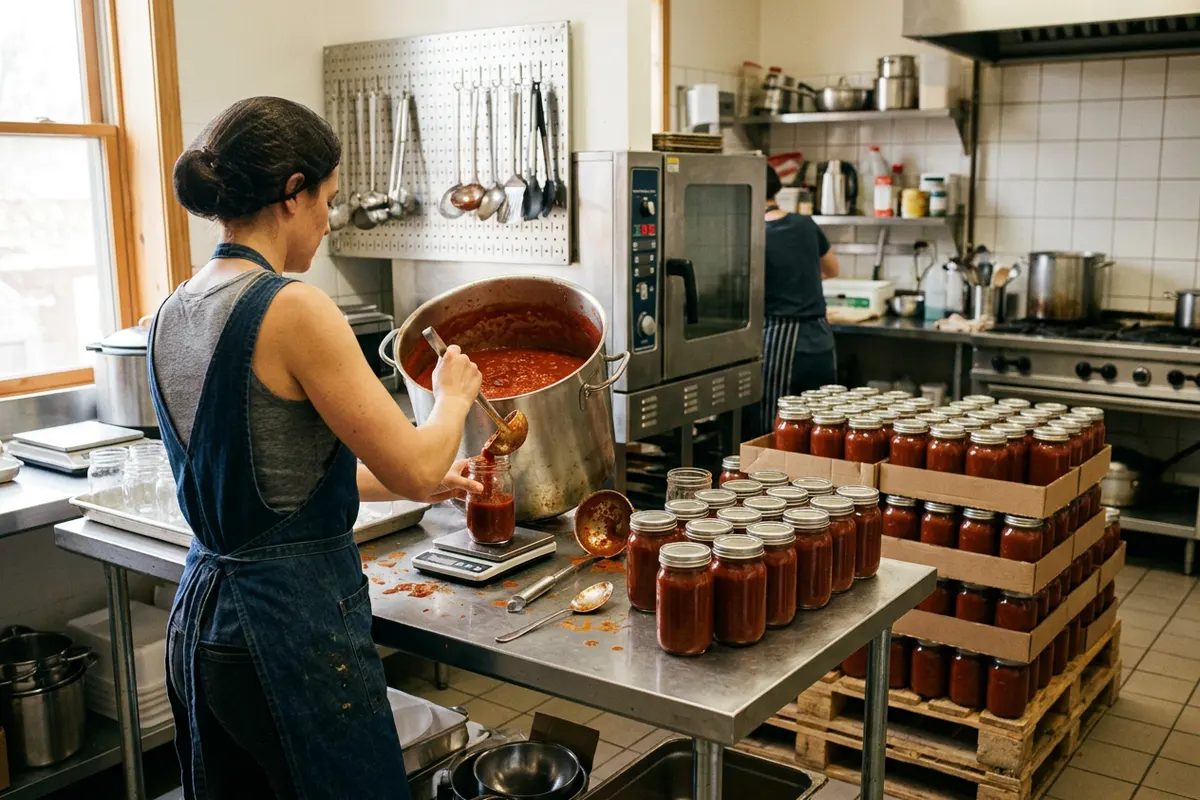
Almost every packaged food brand starts the same way: a founder, a recipe and a few shifts a week in a rented commercial kitchen. It’s the right place to start. You keep control, spend little, and learn what customers actually buy. But at some point the kitchen stops being the cheap option and starts being the thing that limits growth. Here’s how to tell when you’ve reached that point, and what to expect when you hand production to a co-packer.
What each model is good at
| Commercial or shared kitchen | Co-packer | |
|---|---|---|
| Who does the work | You and your staff | The co-packer’s production team |
| Typical batch size | Limited by kettles, ovens and hours booked | Set by line capacity and the co-packer’s minimums |
| Upfront cost | Low: hourly or monthly rental | Higher per run: set-up, minimums, packaging stock |
| Recipe control | Total, change it any day | Locked into a written spec; changes take planning |
| Packaging | Often hand-filled and hand-labelled | Machine filling, sealing, coding and labelling |
| Food safety paperwork | Largely yours | Shared; the co-packer runs its own program |
| Your time | Spent producing | Spent selling and managing the partner |
Six signs you’ve outgrown the kitchen
1. You’re turning down orders, or dreading them
If a new retail listing or wholesale order is a problem rather than a win because you can’t produce it in the hours available, production has become the constraint on your business.
2. The founder’s time is the most expensive ingredient
Add up the hours you and your team spend cooking, filling, labelling and cleaning, and give them a real hourly value. Many founders find their “cheap” kitchen product costs more per unit than a co-packed one once labour is counted honestly.
3. Consistency is slipping
Hand-filling leads to variable fill weights, and small-batch cooking can drift between batches. Retail buyers and repeat customers notice both. Under-filled packages can also fall short of the net quantity on your label.
4. A buyer is asking for things the kitchen can’t provide
Larger retailers and distributors often ask for food safety certifications, product liability insurance, specific case packs, UPC barcodes and lot-coded traceability. A shared kitchen may not be set up to support those requirements.
5. You’re about to sell across provincial borders
Food that is manufactured, packaged or labelled for sale in another province brings the Safe Food for Canadians Regulations into play, including licensing and, for most licence holders, a written preventive control plan. Many brands decide this is the moment to move to a co-packer that already operates under that framework. Our article on who needs an SFC licence when a brand uses a co-packer explains the common set-ups.
6. Your packaging has outgrown the hand-fill
Moving from jars filled with a ladle to stand-up pouches, nitrogen-flushed bags or sealed sachets usually needs equipment a rented kitchen doesn’t have. If the packaging you want for shelf life or shelf appeal needs a machine, you need a partner with the machine. See the options in our packaging formats guide.
When to stay in the kitchen a while longer
Switching too early is a real risk. Stay put if you’re still changing the recipe every month, if you can’t yet sell a co-packer’s minimum run before its shelf life ends, or if your margins only work at kitchen-scale pricing. A co-packer’s minimum order quantity is a commitment to buy ingredients and packaging in volume. Our page on co-packing costs and MOQs explains what drives those minimums. A useful test: can you sell the first co-packed run comfortably within about half of the product’s shelf life? If not, build demand first.
What changes when you switch
- Your recipe becomes a specification. Kitchen recipes measured in cups and “to taste” need to become weights, percentages, process temperatures and times. The co-packer will scale it and may suggest ingredient or process changes so it runs on their equipment.
- You plan production instead of doing it. Runs are booked weeks ahead. Forecasting matters, because a missed slot can mean waiting for the next one.
- Cash moves earlier. Packaging and ingredients are bought in larger lots, often before the run. Expect to fund inventory sooner than you did in the kitchen.
- Paperwork gets real. Expect specifications, allergen statements, label approvals, certificates of analysis for key ingredients and a written agreement covering ownership of the recipe, quality standards and what happens if a run fails.
- Your job changes. You become the brand owner: selling, managing a supplier relationship and protecting quality. For most founders that’s the point of switching.
How to prepare for your first co-packer conversation
- Write the formula in weights. Include every ingredient, its supplier and the batch yield.
- Document the process. Cooking temperatures and times, fill temperature, cooling method and anything else that affects safety or quality.
- Gather product data. Measured pH and water activity for sauces and shelf-stable products, and any shelf-life testing you have.
- Know your packaging. Format, size, fill weight and whether you’ll supply packaging or want it sourced for you.
- Have realistic volumes. Your first-run quantity and a 12-month forecast, even if it’s rough.
- List buyer requirements. Certifications, case packs, labelling or barcode needs your customers have asked for.
Our step-by-step co-packing process page shows what happens from first call to first shipment, and how to choose a co-packer in Canada covers vetting partners.
Where COPACK Canada fits
COPACK Canada co-packs food, sauces, condiments, snacks and beverages from Toronto and Vancouver, with packaging sourcing, labelling, warehousing and freight available alongside production. If you’re weighing the move out of the kitchen, request a quote with your product, packaging and volumes, and we’ll tell you honestly whether you’re ready and what the first run would involve. Sauce brand? Start with our sauce co-packing page.
FAQ
When should a food startup move from a commercial kitchen to a co-packer?
Common signals are turning down orders for lack of capacity, founder labour making units expensive, inconsistent fills, buyer requirements the kitchen can’t meet, plans to sell across provinces, and packaging that needs machine filling.
Is a co-packer cheaper than a commercial kitchen?
Per unit it often is once your own labour is counted, but a co-packer needs larger runs and earlier spending on ingredients and packaging. Compare the full landed cost per unit, not just rental versus quote.
Will a co-packer change my recipe?
A co-packer may suggest changes so the recipe scales and runs safely on its equipment. Agree in writing who owns the formula and approve any changes before production.
What should I bring to a first meeting with a co-packer?
A formula in weights, your process steps, pH and water activity results where relevant, packaging details, first-run and 12-month volumes, and any buyer requirements.
Sources
- CFIA, Food business activities that require a licence under the SFCR (inspection.canada.ca)
- CFIA, Preventive control plan exception for small food businesses (inspection.canada.ca)
- Alberta Agriculture and Forestry, Co-Packing – Food Industry – What to Know (2020)
- Manitoba Agriculture, Using a Co-Packer
This article is general information, not legal, regulatory or food safety advice. Confirm requirements with the CFIA and a qualified advisor.