
On this page
Supplement founders often start the co-packer search by asking about fill weights and pouch sizes. The first question in Canada is a different one: what is your product, legally? A protein powder, an electrolyte drink mix or a vitamin gummy can fall under three different sets of rules depending on its ingredients, its format and what the label says it does. That classification decides which licences you need, what goes on the label and which facilities are allowed to make and pack it.
Three regulatory paths for the same scoop
Health Canada separates products that look like supplements into three broad groups:
- Conventional foods. Products in food formats eaten freely for nourishment or taste, with no added vitamins, minerals or amino acids beyond what food rules allow. A plain protein bar or an unfortified pea-protein baking mix usually sits here. These fall under the Food and Drug Regulations and, for interprovincial trade, the Safe Food for Canadians Regulations (SFCR).
- Supplemented foods. Prepackaged foods with added vitamins, minerals, amino acids, caffeine or other supplemental ingredients for reasons other than nutrition, such as energy drinks, fortified bars and some protein products. Health Canada’s guidance lists ready-to-drink protein shakes and protein dry mixes to be reconstituted among the permitted categories, excluding protein mixes marketed as workout supplements.
- Natural health products (NHPs). Vitamins, minerals, amino acids, botanicals and similar ingredients sold in dosage form or with health claims: capsules, tablets, many gummies, and protein powders marketed as workout supplements with directions for use, which Health Canada says are defined in its Workout Supplements monograph and regulated as NHPs.
When a product in a food format could go either way, Health Canada weighs four criteria together: product composition, product representation (claims, pictures, directions), product format, and public perception and history of use. Format tends to carry the most weight for drinks and conventional foods. If you are unsure, Health Canada’s supplemented foods guidance says you can request a classification determination from its Food Directorate.
If your product is a natural health product
Product licence (NPN)
Under section 4 of the Natural Health Products Regulations, no one may sell an NHP in Canada unless a product licence has been issued for it. Once approved, the product receives an eight-digit Natural Product Number (NPN) that appears on the label. The product licence holder is usually the brand, not the co-packer, so budget time for the application before you book a launch date.
Site licences for every facility that touches it
Section 27 of the same regulations says no one may manufacture, package, label or import an NHP for sale unless they hold a site licence for that activity and follow the good manufacturing practices (GMP) in Part 3. Health Canada also requires site information for each manufacturer, packager, labeller, importer, distributor and storage facility before the NHP can be sold.
In practice this means a food co-packer without an NHP site licence cannot simply fill your capsules or workout powder, even if its equipment could. It also means that if you apply the final label yourself, you may need a site licence for labelling. Health Canada publishes a list of site licence holders, so you can check a prospective partner’s status yourself.
If your product is a supplemented food
Supplemented foods stay on the food side of the line, but they carry extra labelling. Every supplemented food needs a supplemented food facts table instead of a standard nutrition facts table, listing the supplemental ingredients. Some also need a caution identifier on the front panel and a list of cautionary statements, for example where a product isn’t recommended for children or pregnant people. Health Canada’s transition period for products already on the market ended on December 31, 2025, so every supplemented food on shelves now must meet the full rules.
Because supplemented foods are foods, the SFCR applies to manufacturing, packaging and labelling for interprovincial trade. Our article on who needs an SFC licence when a brand uses a co-packer walks through the common set-ups.
If your product is a conventional food
A protein bar, nut butter or baking mix without supplemental ingredients follows ordinary food rules: a bilingual label, a nutrition facts table, allergen declarations and, since January 1, 2026, a front-of-package nutrition symbol where the product exceeds the thresholds for saturated fat, sugars or sodium. Be careful with wording. A claim about building muscle or supporting immunity can push a food-format product toward NHP status, so settle your claims before you print.
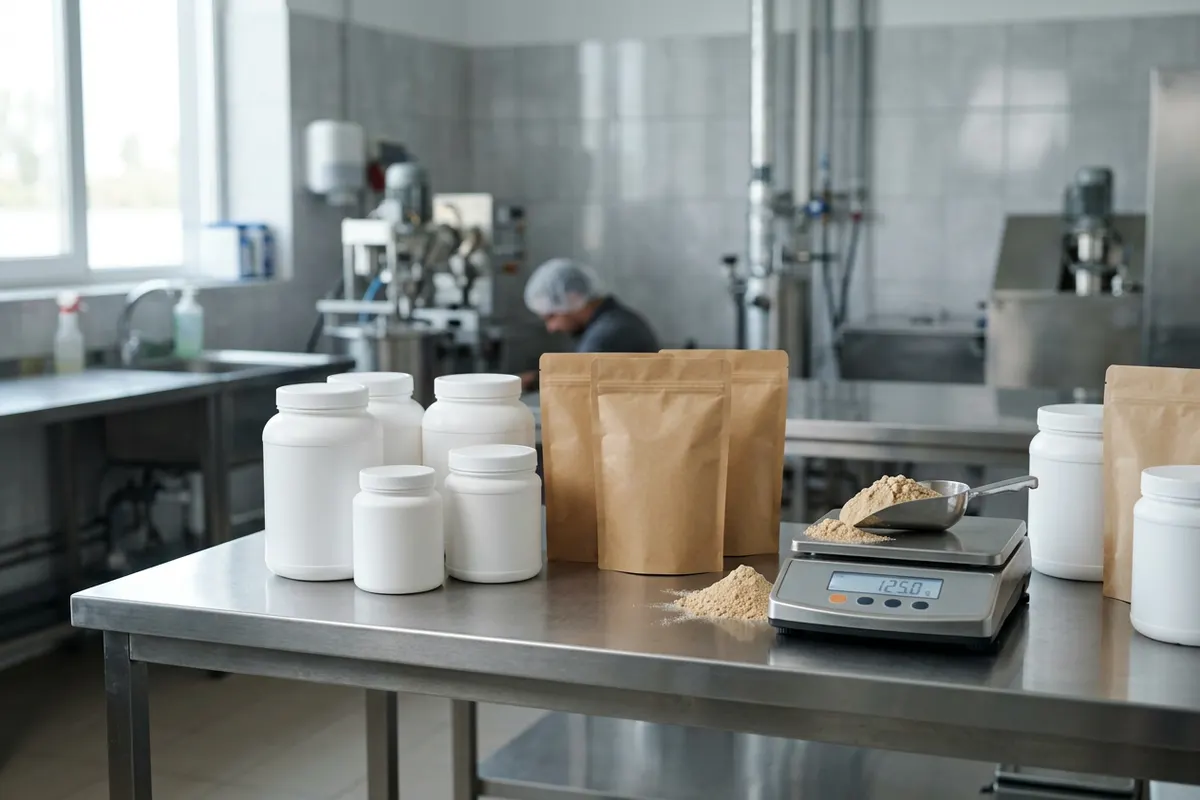
Packaging decisions that matter for powders and supplements
Whatever the classification, the physical product brings its own packaging questions to the co-packer:
- Moisture and oxygen. Protein and greens powders, electrolyte mixes and gummies are sensitive to humidity. Ask for barrier films or liners suited to your shelf-life target and whether the line can add a desiccant or oxygen absorber. Our packaging formats guide compares pouches, tubs and other options.
- Format. Tubs and stand-up pouches suit multi-serve powders; stick packs and sachets suit single servings and sampling. Each has different minimums and filling equipment, so confirm the format before comparing quotes.
- Scoops and serving accuracy. If your label states a serving in grams and a scoop size, the scoop needs to deliver it with your powder’s actual density. Test it.
- Lot codes and dates. NHPs and foods both need traceability. Agree on how lots are defined and printed. A tighter lot keeps a recall smaller.
COPACK Canada’s packaging sourcing service can source pouches, films and containers to suit the product, alongside co-packing.
Questions to ask a supplement co-packer
- Is my product a food, a supplemented food or an NHP in your view, and has that been confirmed against Health Canada guidance?
- For NHPs: which site licence do you hold, and does it cover manufacturing, packaging and labelling for my dosage form?
- For foods: does your SFC licence cover the activities and food category, and who applies the final label?
- What testing comes with each lot, and what certificates of analysis will I receive?
- What are your minimums for my format, and how do they change between tubs, pouches and stick packs?
- Who sources the ingredients, and who holds the supplier documentation?
For the wider selection process, see how to choose a co-packer in Canada. To understand pricing before you ask, read co-packing costs and MOQs.
Where COPACK Canada fits
COPACK Canada works with Canadian brands in food and beverage, nutritional and protein supplements, and beauty and personal care, from Toronto and Vancouver. Tell us what your product is, how it’s classified (or that you’re not sure yet), and the format you have in mind. When you request a quote, include your target volume and any certificates your buyers require, and we’ll tell you what we can take on and what you’ll need to have in place first.
FAQ
Is protein powder a food or a natural health product in Canada?
It depends on composition, format and claims. Health Canada lists protein dry mixes as a permitted supplemented food category, but protein mixes marketed as workout supplements with directions for use are defined in its Workout Supplements monograph and regulated as natural health products.
Who needs an NPN, the brand or the co-packer?
An NPN is issued with a product licence for a specific product, and no one may sell an NHP without one. The product licence holder is normally the brand selling the product. The co-packer needs a site licence for the activities it performs.
Can any food co-packer make my supplement?
Not if it is a natural health product. Anyone who manufactures, packages, labels or imports an NHP for sale must hold a Health Canada site licence for that activity and follow NHP good manufacturing practices.
What is a supplemented food facts table?
It replaces the nutrition facts table on supplemented foods and lists the supplemental ingredients added. Some supplemented foods also need a front-of-pack caution identifier and cautionary statements.
Sources
- Health Canada, Guidance document: Supplemented Foods Regulations (canada.ca)
- Health Canada, Supplemented foods: Regulations and compliance (canada.ca)
- Health Canada, Guidance Document: Classification of products at the food-natural health product interface: products in food formats (canada.ca)
- Natural Health Products Regulations, SOR/2003-196, sections 4, 22 and 27 (laws-lois.justice.gc.ca)
- Health Canada, Site Licensing Guidance Document and List of site licence holders (canada.ca)
- CFIA, Implementation of the Food and Drug Regulations amendments: front-of-package nutrition symbol (inspection.canada.ca)
This article is general information, not legal or regulatory advice. Confirm requirements with Health Canada and a qualified regulatory advisor.